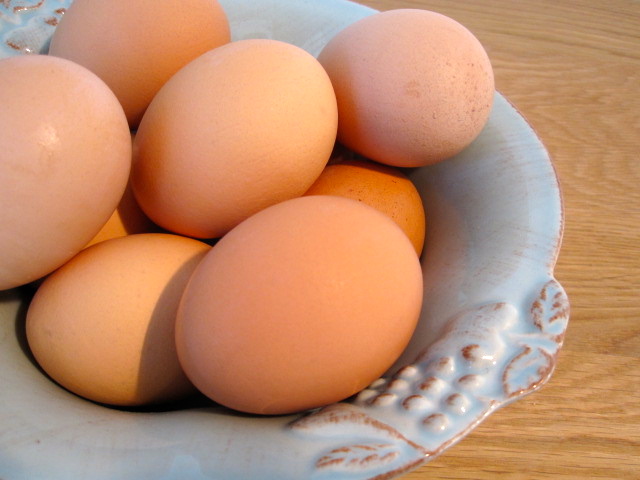
Tuesday, October 11, 2011

Culinary IQ: Tuesday, October 11, 2011; Beating Egg Whites


Beating Egg Whites
This is a beating you can give without being called a bully!
The purpose of beating egg whites is to use them in baked goods and custards or sauces to lighten them. They are also used in different forms of icing for cakes and toppings for pies. Beaten egg whites are a leavening element in baked goods.
Here are a few tips to follow before you start beating the egg whites.
  1. It is best to separate the eggs cold but let the egg whites come to room temperature before beating.
  2. Always use a clean bowl that is free of oil or grease. Copper bowls are considered by many to be the best bowl to beat egg whites in. Copper bowls are usually expensive and not easy to find. Stainless steel is the most reasonable choice for beating egg whites. Avoid aluminum as it can turn the egg whites gray. Glass should be avoided because the egg whites slip on the surface and can take much longer to beat and full volume is harder to achieve. Plastic and rubber bowls should be avoided because grease and oil can stick in scratches in the bowl.
  3. Egg whites can be beaten by hand using a whisk or in an electric mixer using the whisk attachment. Once proper methods are learned it can be just as easy to beat them by hand as it is in an electric mixer. Beating them by hand also gives you more control in achieving the proper stage of beating.
  4. Acid and sugar act on egg whites to make the cell structure more stable. A common acid for use in egg whites is cream of tarter (a pinch) but a small amount of lemon juice or vinegar can be used. Taste is always a consideration when selecting the acid. Salt and acid can be added to the egg whites in the beginning. Sugar, however, should be added once the egg whites have been beaten to a foam similar to the foam on a cappuccino.
  5. Begin beating the egg whites on low and then increase to medium until foaming is achieved. Beating too fast will cause larger unstable cells.
  6. Once foam is achieved, sugar should be gradually rained into the egg whites as they are beaten. While sugar helps stabilize the air cells it also adds weight to the egg whites and increases the time required to achieve the desired texture of egg white. If sugar is used in the egg whites it is near to impossible to over whip the egg whites.
  7. There are typically 3 stages of beaten egg whites, soft peak, medium peak and stiff peak. Egg whites can be tested by stirring the whisk or whisk attachment in the egg whites and lifting it vertically out and inverting it. Soft peak should have structure but will only hold a soft peak that tends to fall away. Medium peak is accomplished when the point of egg white falls to approximately a 45 degree angle. Stiff peak is reached when the point remains erect with only a minimal angle at the very top of the point. The egg whites also become more shiny as they progress through the stages.
  8. When incorporating egg whites into other mixtures you should always fold and not mix them in. Egg whites should always be incorporated into the heavier mixture and not the opposite. A sacrifice of a small amount of the whites can be mixed into the heavier mixture to lighten it and help it except the egg whites more easily. Add egg whites in a few smaller amounts. Using a spatula scrape around the edges of the bowl turning the heavier mixture over the egg whites. Mix only until the egg whites are fully incorporated and no streaks are evident.
Once you have mastered the ability to beat and use egg whites properly you will be able to make some of the most delicate and sought after dishes and desserts known to man!

Monday, October 10, 2011

Culinary IQ: Monday, October 10, 2011; Make up of an Egg


The Make-up of an Egg
The egg came first! At least it does in Culinary IQ. I hope you find the information about the egg and how to use it in the kitchen this week useful. If you have any other foods or kitchen items you would like me to discuss in Culinary IQ, please let me know.


Eggs have six distinct parts: thin white, thick white, yolk, shell, air cell, and chalazae. About two-thirds of the weight of the edible part of an egg is egg white; about one-third is the yolk. Overall, most of the whole egg is moisture, with smaller amounts of protein, fat, and emulsifiers.
White
Another name for the egg white is egg albumen. Other than small amounts of mineral ash and glucose, egg whited consists entirely of protein and water. While the special mix of proteins in egg white is extremely important to its functionality, egg white is actually mostly water, about 90 percent water and only 10 percent protein.
Compared to the yolk, egg white has very little flavor or color. It has both thick and thin portions, with the thick portion thinning as the egg ages. As it thins, egg white loses its ability to form foams that are stable.
Yolk
Egg yolks are about half moisture and half yolk solids. As eggs age, yolks pick up additional moisture from the white. When this happens, the yolk thins out and flattens when the egg is cracked into a smooth surface. It has a protective membrane that weakens as it ages, making it more difficult to separate the yolk from the white. The weakening of this membrane also increases the possibility that bacteria will pass into the nutrient-rich yolk where they can multiply if the egg is not kept cold.
The solids in egg yolks consist of proteins, fats, and emulsifiers, with small amounts of mineral ash and yellow-orange carotenoids. Egg yolk proteins are not the same as egg white proteins. Many egg yolk proteins are lipoproteins, proteins bound to fats and emulsifiers, which are both lipids.
The most well-known emulsifier in egg yolk is lecithin. Egg yolk contains an incredibly high amount of lecithin, about 10 percent. Like most of the lipids in egg yolk, lecithin is bound as lipoproteins. The emulsifying lipoproteins perform many functions in foods, most notably bonding to both water and oil. By bonding to both, emulsifiers and emulsifying lipoproteins hold together, or bind, complex mixtures of ingredients, such as cake batters.
An important factor in the color of egg yolk is the hen’s feed. The more carotenoids in the feed, the more yellow-orange the yolk. Alfalfa and yellow corn, which are both high in carotenoids, produce deeply colored yolks. Wheat, oat, and white corn produce lighter yolks. When feed is naturally low in carotenoids, marigold petals, which are a rich source of carotenoids, can be added for color.
The hen’s feed also affects the flavor of the yolks. This explains why some brands of eggs taste different from others. Sometimes, for example, organic eggs tasted different from regular eggs. It isn’t that being organic necessarily gives them a different flavor; more likely, the growers are using a particular feed that - organic or not - has a distinct flavor that passes into the egg.
Omega-3-fatty acids are sometimes added to feed for hens so that the eggs are high in this healthful oil. Eggs that contain omega-3-fatty acids will have a different flavor from regular eggs.


Shell
Eggshell represents about 11 percent of the weight of eggs. Although it serves as a hard protective covering, the eggshell is porous. This means that odors penetrate eggshells, and moisture and gases (primarily carbon dioxide) can escape. In commercial practice, shell eggs are washed and sanitized to remove dirt and to reduce the likelihood of salmonella contamination. They are also lightly coated with mineral oil to delay moisture loss. 
Eggshell color can be either brown or white, depending on the breed of hen. Hens with white feathers and white earlobes lay white eggs, hens with red feathers and red lobes lay brown eggs. While most (95 percent) commercial breeds produce white eggs, hens bred in parts of New England produce brown eggs. Shell color has no effect on flavor, nutrition, or functionality of eggs.
Air Pocket
Eggs contain two protective membranes between the shell and the white. Soon after an egg is laid, an air cell forms between the membranes at the egg’s larger end. As the egg ages, loses moisture, and shrinks, the air pocket increases in size. This is why older eggs float in water while fresh ones sink.

Chalazae
The chalazae are twisted white cords that hold the yolk to the center of the egg. They disintegrate as the egg ages. Chalazae are an extension of the egg white and are completely edible, although pastry chefs typically us a chinois or sieve to strain them from certain products such as custards.
Figoni, P. (2008). How Baking Works: Exploring the Fundamentals of Baking Science. Hoboken, New Jersey: John Wiley & Sons, Inc.

Thursday, October 6, 2011

Culinary IQ

Starting next week I will be doing weekday posts on various foods and other items related to cooking. Please check back on a daily basis for valuable information. My first topic will be eggs. Which came first?

Doing time at the Times!

I have started an exciting new stage of my culinary education, my externship! I am pleased to be doing mine at the Los Angeles Times test kitchen. Yes I am following in the footsteps of Marian Manners and Prudence Penny. I think it is safe to say that anyone reading this post will be too young to remember either one. Both were pseudonyms for the various food instructors and writers and later editors in the early days of Los Angeles Times. Yes, some of them were even males. I am currently working with 4 other interns from various culinary schools. We test the various recipes and kitchen tools that will be featured in the paper's food section including cookbook reviews, Culinary SOS and recipes that will be demonstrated on KTLA/5's Eatbeat. 
The most recent recipe I made was for a vegetable soup from the Coral Tree Cafe so it could be photographed for a possible Culinary SOS article. Look for the recipe in an upcoming issue!
 I am sure my experience at the times will be invaluable and rewarding.

Monday, July 18, 2011

What About Marzipan?


After I ranted about fondant yesterday I have found a delicious option, marzipan. It may not be as versatile as fondant but it definitely makes a beautiful cake. One could also argue that it is a local food as we have almond orchards within 250 miles of Los Angeles! For those of you who say marzipan is too sweet I say - dessert is supposed to be sweet, eat less!

Sunday, July 17, 2011

What the F#*@ant!


Yes I just dropped the "F" bomb, Fondant! Which is more important, beauty or taste? After recent years of watching fondants becoming the preferred medium for finishing specialty cakes, I finally got to use it myself. Back to my earlier question, I think taste is more important. I am troubled by the wast involved in what I presume is millions of pounds of fondant that are being sold only to be ripped off a piece of cake before eating and ultimately thrown away. Couldn't the ingredients in fondant be made into something more appetizing and used to help feed some of the hungry in this world? What do you think?